

The Managed Variable World
How supply chains, platforms, technology partners, and geopolitical relationships are being reclassified under failure cost

Ordering Applied Brief · No. 01
This applied brief examines how useful actors across supply chains, platforms, technology systems, capital networks, and geopolitical relationships are being reclassified from trusted partners into managed variables under rising failure cost.
This is the first Ordering Applied Brief: a shorter cross-domain application format designed to connect the Ordering framework to current institutional problems.
This brief sits alongside the Ordering Case Notes Series. It is not part of the eight-part case sequence. It is a cross-domain application of a mechanism developed in Ordering and Working Paper No. 03.
Opening: The World Is Reclassifying
The world is not simply decoupling.
It is reclassifying.
Many actors are not being expelled.
They are being retained — but under new carrying conditions.
They remain useful.
They lose discretion.
They become managed variables.
This is one of the defining patterns of the current institutional environment.
A supplier may remain critical.
A platform may remain efficient.
A technology provider may remain powerful.
A capital source may remain valuable.
A state may remain necessary.
But the relationship changes when failure cost rises faster than trust can absorb.
The system may still need the actor’s function, scale, expertise, technology, capital, infrastructure, or access.
But it no longer trusts the actor’s judgment, alignment, continuity, or discretion enough to carry the relationship in its previous form.
At that point, the question changes.
The system no longer asks only:
Is this actor valuable?
It asks:
Can this actor still be trusted with discretion?
That is the managed variable shift.
Ordering Mechanism: From Partner to Managed Variable
A managed variable is an actor that remains useful but is no longer trusted with discretion.
It is not simply an enemy.
It is not simply a failed partner.
It is not simply a supplier risk.
It is not simply an actor whose value has disappeared.
A managed variable is more specific.
It is an actor the system still uses, but no longer allows to operate as a trusted discretionary participant.
The shift does not require open hostility.
It does not require formal rupture.
It does not require the actor to be removed from the system.
The actor may remain inside the system.
But it is carried differently.
Failure cost rises.
Alignment becomes doubtful.
Trust becomes expensive.
Discretion becomes risky.
Monitoring increases.
Redundancy becomes normal.
Access becomes conditional.
The actor remains useful, but under management.
The system does not need to reject the actor.
It only needs to stop trusting its discretion.
That is enough to change the relationship.
This is why the standard vocabulary is incomplete.
“Decoupling” describes one possible outcome.
But many systems do not decouple.
They keep the actor.
They change the carrying conditions.
That is managed continuation.
The relationship continues, but the trust structure underneath it has changed.
Where This Is Happening
Supply Chains
A supplier may remain critical, efficient, and high-quality.
But once the buyer begins treating the supplier’s continuity, jurisdiction, political exposure, or alignment as uncertain, the relationship changes.
The supplier is no longer simply a partner in production.
It becomes a managed variable in the buyer’s viability structure.
The relevant failure cost is not only price. It is production continuity, delivery reliability, strategic dependency, and the cost of being unable to adjust under stress.
The signals are familiar: dual sourcing; localization; audit expansion; inventory buffers; alternative routing; supplier visibility tools; contractual controls.
These signals do not mean the supplier has lost value.
They mean the system no longer carries the supplier’s discretion, continuity, or reliability as an unpriced assumption.
The supplier remains inside the system.
But it is now surrounded by buffers.
Cloud Infrastructure
A cloud provider may remain reliable, scalable, and technically superior.
But if outage risk, pricing power, jurisdiction, data exposure, or platform lock-in becomes too costly to ignore, clients begin to carry the provider differently.
The provider remains useful.
But the relationship becomes bounded by exit planning, redundancy, data controls, procurement review, and governance layers.
The relevant failure cost is not only service interruption. It is business continuity loss, data sovereignty exposure, switching-cost lock-in, and the cost of discovering too late that critical operations cannot be moved.
The signals include: multi-cloud strategy; data residency requirements; exit plans; critical workload segmentation; dependency mapping; vendor risk committees.
The provider is not rejected.
It is retained under constraint.
The system continues using the capability while reducing the consequences of trusting it too completely.
AI Systems
An AI model provider may remain powerful and productive.
But institutions increasingly stop treating the system as a fully dependable capability once data leakage, alignment risk, hallucination exposure, accountability gaps, or operational opacity becomes material.
The problem is not always the provider’s intention.
Often it is the model’s predictability, traceability, and governance boundary.
The capability stays.
Discretion is withdrawn.
Use becomes managed.
The relevant failure cost is not only wrong output. It is decision error, accountability failure, compliance exposure, data leakage, reputational damage, and the inability to explain why a system produced a consequential result.
The signals include: human review; data restrictions; model governance; approved-use lists; audit logs; segmented deployment; vendor risk controls.
This is not a rejection of AI capability.
It is a reclassification of how that capability can be carried.
Critical Minerals and Strategic Inputs
A source of critical minerals or strategic components may remain necessary.
But states and firms may stop treating availability as a commercial assumption.
The source becomes a managed variable inside national strategy and industrial planning.
The relevant failure cost is not only higher input price. It is industrial interruption, defense exposure, energy constraint, production bottleneck, and strategic vulnerability.
The signals include: stockpiling; friend-shoring; export controls; strategic reserves; industrial policy; alternative sourcing.
The input remains necessary.
The assumption of neutral availability disappears.
The system does not merely ask whether the input is cheap or efficient.
It asks whether dependence on that input can be carried under stress.
That is a different question.
Capital Networks
A capital provider may remain attractive.
But source-of-capital scrutiny, sanctions risk, political exposure, reputational cost, or strategic dependency may change its status.
The investor remains a capital source.
But no longer a neutral partner.
The relevant failure cost is not only financial loss. It is governance compromise, sanctions exposure, reputational exposure, strategic dependency, and the cost of accepting capital that later becomes difficult to carry.
The signals include: beneficial ownership review; national security screening; co-investor controls; funding source diligence; governance rights limitations; exit restrictions.
Capital still enters the system.
But it enters under classification.
The money remains useful.
The discretion attached to the money is repriced.
Geopolitical Relationships
A state may remain necessary to another system’s energy, security, trade, technology access, or regional strategy.
But trust may be replaced by conditionality, hedging, monitoring, and managed dependence.
The relationship does not disappear.
It becomes more heavily governed.
The relevant failure cost is not only diplomatic disagreement. It is security exposure, alliance dependency, regional instability, strategic coercion, and the cost of relying on a partner whose priorities may no longer remain aligned under pressure.
The signals include: security reviews; export controls; alliance diversification; conditional access; strategic hedging; parallel institutions.
This is not always decoupling.
The relationship does not end.
But the architecture underneath it changes.
That is managed continuation under repriced trust.
What Misclassification Costs
Misclassification cuts both ways.
If a system treats a managed variable as a trusted partner, it may carry unpriced failure cost into the next crisis.
If it treats a still-useful actor as an enemy, it may destroy capacity the system still needs.
The diagnostic task is not to moralize the actor.
It is to classify the relationship correctly.
A managed variable is not a call for rejection.
It is a call for bounded continuation.
Diagnostic Questions
The central question is:
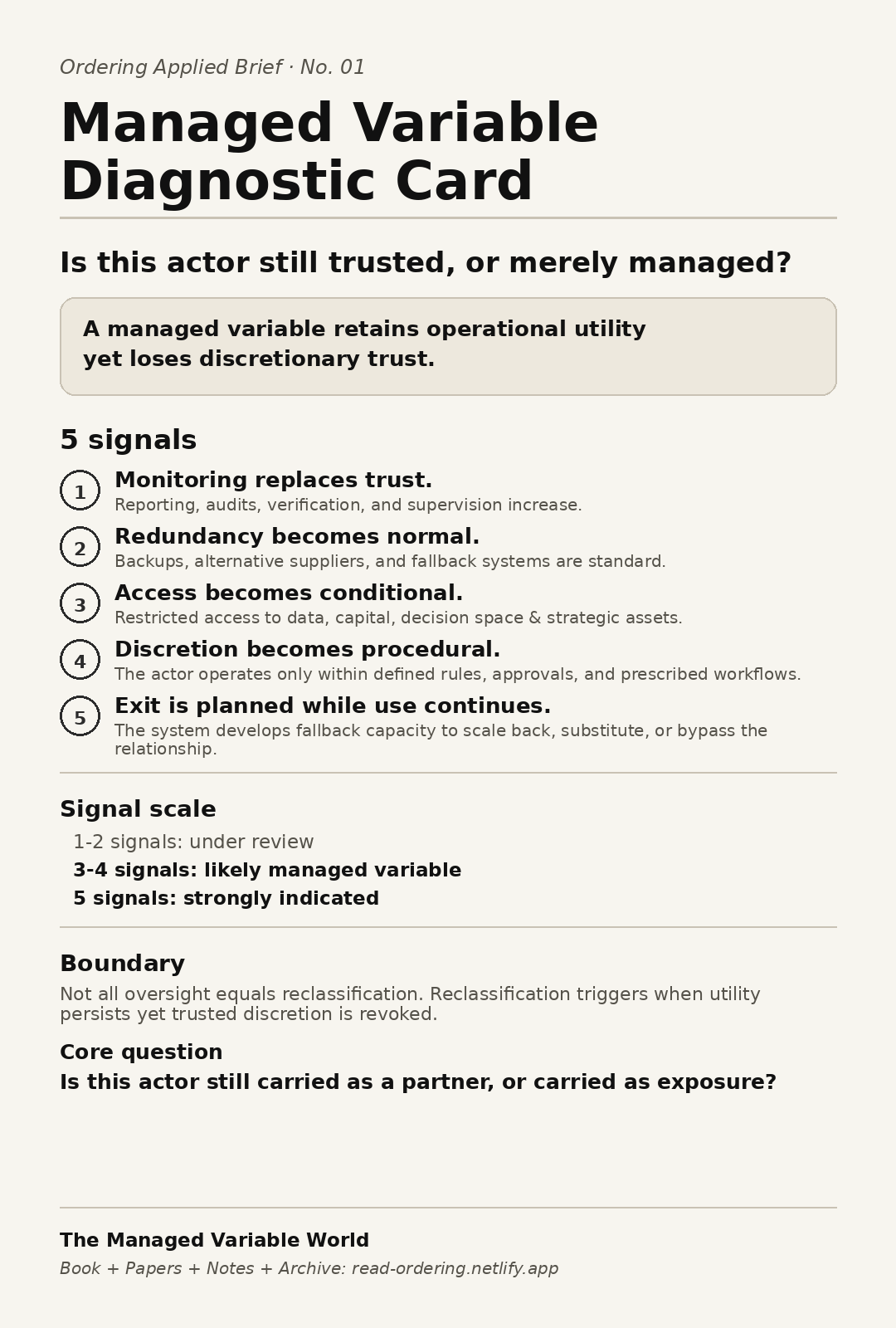
Is this actor still trusted, or merely managed?
More specifically:
Can the actor still exercise discretion without triggering system anxiety?
Does the system still treat the actor’s judgment as aligned?
Has monitoring replaced trust?
Has redundancy become normal?
Has access become conditional?
Has the relationship become more procedural, more audited, or more reversible?
Would removing the actor damage the system, while leaving it unbounded would also create unacceptable failure cost?
Is the actor still carried as a partner, or carried as exposure?
These questions matter because continuity can mislead.
A relationship that continues is not necessarily a relationship that trusts.
The actor may still perform.
The system may still pay.
But if discretion has been repriced, the relationship has already changed — whether or not the surface has changed with it.
Misuse Boundary
Not every increase in monitoring or governance is reclassification.
Routine compliance, operational prudence, and scale-related controls exist independently.
The managed-variable shift occurs only when usefulness remains while trusted discretion is deliberately withdrawn.
That is the boundary.
The difference depends on whether oversight is routine verification or a response to withdrawn discretion.
Misread it, and you will either carry hidden failure cost or destroy capacity you still need.
There is no universal numerical threshold at which this shift occurs.
The threshold depends on failure cost, reversibility, substitutability, sector, and system tolerance.
Some relationships deepen under pressure because repeated stress confirms alignment.
The concept should not be used to describe all constraint, all oversight, or all risk management.
It applies when usefulness remains, but discretion is no longer trusted enough to be carried unbounded.
Reclassification is not passive.
Actors that feel themselves becoming managed variables may diversify customers, build alternative markets, reduce dependence on the managing system, develop substitute technology, or seek counter-alignment.
That response does not weaken the diagnosis.
It confirms it.
Once both sides begin managing dependence, the relationship has already moved beyond ordinary partnership.
What Ordering Adds
The standard language often speaks of:
supply-chain risk;
vendor risk;
platform dependency;
geopolitical tension;
decoupling;
de-risking;
compliance tightening.
Those descriptions are useful.
But they are incomplete.
Ordering adds a classification question:
What happens when an actor remains useful but loses trusted discretion?
This changes the diagnosis.
The actor’s function may remain valuable.
Its discretion is repriced.
That is the shift.
When failure cost rises, the system may not remove the actor.
It may reclassify the actor.
This distinction matters because many systems misread reclassification as rejection.
But the more common pattern is not removal.
It is managed continuation.
A partner becomes a managed variable when the system still needs the actor’s function but no longer trusts its discretion enough to carry the relationship in its previous form.
That is why continuity alone is not evidence of trust.
The relationship may continue.
The operating logic may already have changed.
This brief does not call for blanket decoupling or moral judgment.
It offers a colder diagnostic:
when failure cost rises faster than trust, systems rarely remove useful actors.
They reclassify them.
Ordering gives you the language and tools to see this shift early — before it hardens into policy, contract, or irreversible architecture.
The new world is not only a world of broken relationships.
It is a world of retained actors under reduced trust.
Direction to Ordering
This brief extends Chapter IV of Ordering: How Systems Reprice When Failure Becomes Expensive: Priority Misalignment and Structural Gravity — the chapter that develops how systems change the carrying conditions of useful actors without removing them.
It connects to Working Paper No. 03, From Partner to Managed Variable.
It also connects to Tool 08, The Managed Variable Test, and Concept 12, Managed Variable.
The papers develop the mechanisms.
The book develops judgment.
Book + Papers + Notes + Archive:
https://read-ordering.netlify.app/
Series guide and framework overview:
https://doi.org/10.5281/zenodo.20485150
Citation:
Reed, C. (2026). Ordering Applied Brief No. 01: The Managed Variable World. Notes on Ordering. Retrieved from
