

The Managed Variable Test
How to detect when a useful actor has lost discretionary trust

Ordering Tools Series · Tool 08
This tool examines how to detect when an actor remains useful to a system but is no longer trusted with discretion.
This tool belongs to the Ordering Tools Series — a set of diagnostic instruments derived from the Ordering framework for reading systems under pressure.
Tool map
Five signals
Signal readout
Weighted reading
Partial managed-variable conditions and domain map
Test questions
Reading the result
Assessment record sheet and pack
Example readout
Carrying strategy
Misuse boundary
This tool is the diagnostic companion to Ordering Applied Brief No. 01, The Managed Variable World, which describes the broader cross-domain pattern.
A managed variable is not an actor the system no longer needs.
It is an actor the system still needs, but no longer trusts with discretion.
That distinction matters because continuity can mislead.
A supplier may still deliver.
A platform may still function.
A cloud provider may still host critical workloads.
An AI system may still produce useful output.
A capital source may still provide funding.
A state may still remain strategically necessary.
But the relationship may already have changed.
The actor remains inside the system.
The carrying conditions around the actor have been rewritten.
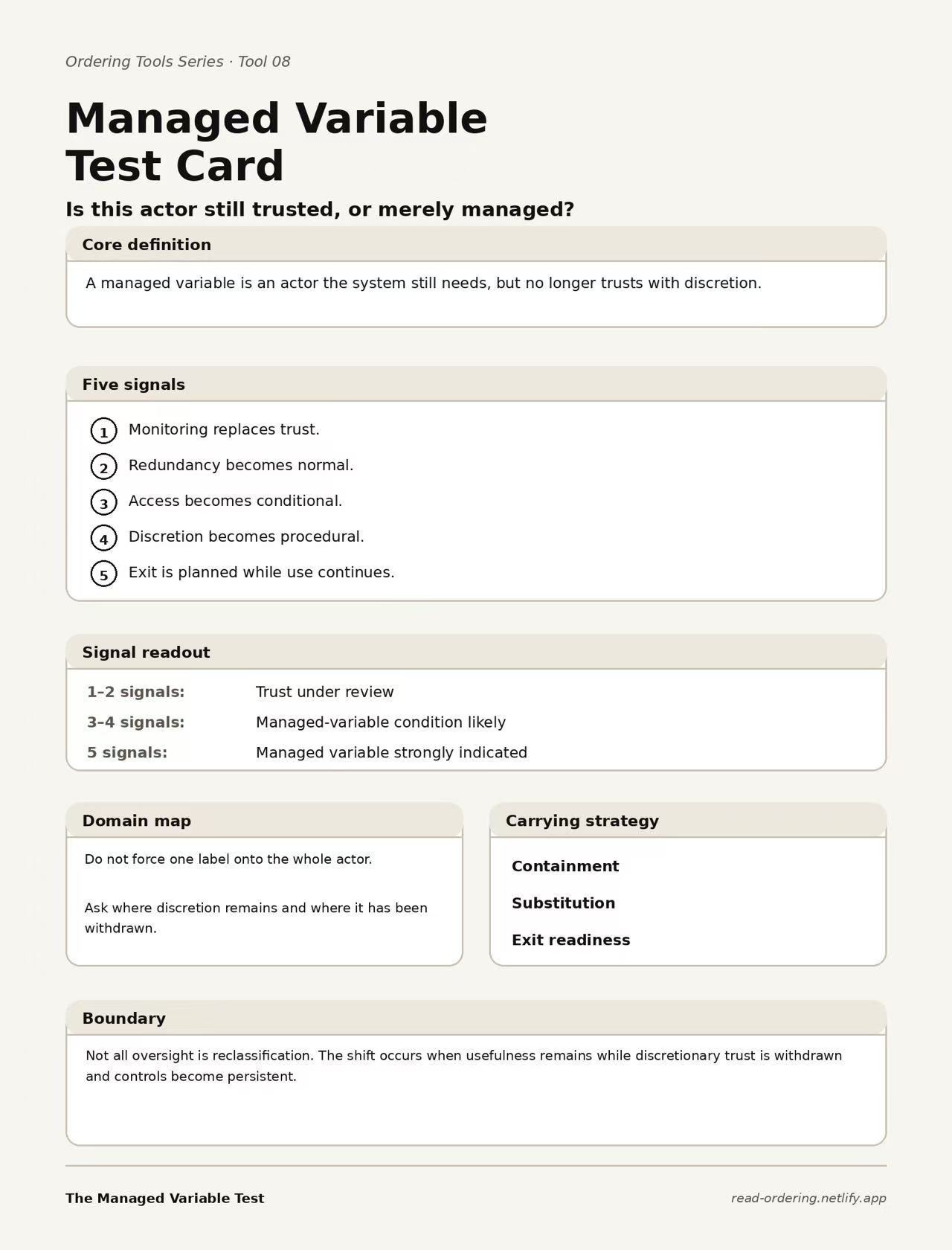
The Managed Variable Test is designed to detect that shift.
Its central question is simple:
Is this actor still trusted, or merely managed?
What This Tool Diagnoses
The Managed Variable Test diagnoses a relationship shift.
It does not ask whether the actor still has value.
It asks whether the system still trusts the actor with discretion.
The actor may remain productive, necessary, efficient, or strategically valuable.
But if monitoring replaces trust, redundancy becomes normal, access becomes conditional, discretion becomes procedural, and exit is planned while use continues, the relationship is no longer operating as ordinary partnership.
It has entered managed continuation.
That is the condition this tool is designed to detect.
The Managed Variable Test does not moralize the actor.
It classifies the relationship.
Where Applied Brief No. 01 identifies the managed-variable world, this tool shows how to read whether a specific relationship has entered it.
The Core Distinction
A trusted partner is carried through judgment.
A managed variable is carried through controls.
An enemy is opposed.
A failed actor is replaced.
A managed variable is neither.
It remains inside the system because its function still matters.
But the system no longer carries its discretion as an unpriced assumption.
This distinction matters because many systems misread continuity as trust.
They see that the supplier is still delivering.
They see that the platform is still used.
They see that the investor is still present.
They see that the state relationship still exists.
They conclude that trust remains.
But continuity alone is not evidence of trust.
A relationship can continue after its operating logic has changed.
The actor may still be used.
The actor may still be paid.
The actor may still be described in polite language.
But if the system has withdrawn discretionary trust, narrowed access, increased verification, built redundancy, and planned exit capacity, the actor is no longer carried as an ordinary partner.
It is carried as a managed variable.
The Five Signals
Signal 1 — Monitoring Replaces Trust
Monitoring does not automatically mean distrust.
Large systems monitor many things.
The signal becomes diagnostic when monitoring is no longer routine verification, but a substitute for trusted discretion.
In an ordinary partnership, the system may review performance, check compliance, and verify delivery while still allowing the actor to exercise judgment.
In a managed-variable condition, that changes.
Reporting increases.
Audits expand.
Verification becomes more frequent.
Supervision becomes tighter.
The system asks for proof before it carries trust.
The question is not whether monitoring exists.
The question is what monitoring has replaced.
If monitoring replaces ordinary confidence in the actor’s discretion, the relationship has begun to change.
Signal 2 — Redundancy Becomes Normal
Redundancy is often treated as inefficiency in stable conditions.
A single trusted supplier is cheaper.
A single platform is easier.
A single cloud provider is simpler.
A single capital source is faster.
But when failure cost rises, redundancy changes meaning.
Backups, alternative suppliers, parallel channels, fallback systems, reserve capacity, and substitute relationships no longer look wasteful.
They become responsible design.
When redundancy becomes normal, the system is no longer optimizing around a single trusted relationship.
It is reducing the cost of dependence.
The actor may remain useful.
But the system no longer wants the actor to be load-bearing without alternatives.
Signal 3 — Access Becomes Conditional
Conditional access is one of the clearest signs that an actor remains useful but is no longer fully trusted.
The system does not remove the actor.
It narrows the actor’s operating perimeter.
This is not the same as exclusion.
Access to data may be restricted.
Access to capital may be reviewed.
Access to infrastructure may become segmented.
Access to markets may become conditional.
Access to decision space may be reduced.
Access to strategic information may be limited.
The actor is still inside the system.
But the system no longer allows the actor to move through the relationship as a trusted discretionary participant.
The question becomes:
What can this actor still touch?
What can it still know?
What can it still decide?
What can it still influence without permission?
When these boundaries narrow while use continues, the relationship is moving toward managed-variable status.
Signal 4 — Discretion Becomes Procedural
Discretion is the ability to exercise judgment under conditions not fully specified in advance.
A trusted partner is allowed some interpretive room.
It can adjust.
It can respond.
It can make judgment calls.
It can carry ambiguity.
A managed variable cannot.
The actor can still act, but only inside defined rules, approvals, and prescribed workflows.
The system is not only watching the actor.
It is scripting the actor’s room for judgment.
This is the difference between supervision and proceduralization.
Supervision watches behavior.
Proceduralization narrows what behavior is allowed to be.
When discretion becomes procedural, the actor’s function may remain.
But the actor’s judgment is no longer trusted enough to carry ambiguity.
The actor still moves.
But it moves inside a smaller field.
Signal 5 — Exit Is Planned While Use Continues
Exit planning does not mean exit is imminent.
It means dependence has become expensive enough that the system wants an option it previously did not build.
This is one of the strongest managed-variable signals.
The system continues using the actor.
But it also develops fallback capacity to scale back, substitute, or bypass the relationship.
A firm continues buying from a supplier while qualifying alternatives.
A company continues using a platform while building export paths.
An institution continues using an AI system while limiting deployment and preparing substitutes.
A government continues a relationship while diversifying alliances, infrastructure, or strategic inputs.
This is not ordinary partnership.
It is managed continuation.
The actor remains useful.
But the system no longer wants to be trapped by usefulness.
When exit capacity is built while use continues, the relationship is already being carried differently.
Signal Readout
The Managed Variable Test does not produce a mathematical verdict.
It produces a pressure reading.
The number of signals matters, but the meaning of those signals matters more.
1–2 Signals: Trust Under Review
One or two signals indicate that trust is under review.
The system may be responding to scale, regulation, temporary uncertainty, or a specific incident.
At this level, do not overread the relationship.
A new audit may be routine.
A backup supplier may be prudent.
A temporary access restriction may be situational.
The relationship may not have been reclassified.
But the shift may be beginning if the controls persist, normalize, and become difficult to reverse.
3–4 Signals: Managed-Variable Condition Likely
Three or four signals indicate that the managed-variable condition is likely.
The actor remains useful.
But the system no longer carries the actor through ordinary trust.
Monitoring, redundancy, conditional access, procedural discretion, and partial exit capacity have begun to form a management structure around the relationship.
This is the point where polite partnership language may become misleading.
The relationship may still appear cooperative.
But the system is already redesigning the carrying conditions.
At this level, the actor should not be read simply as a partner.
It is becoming a managed variable.
5 Signals: Managed Variable Strongly Indicated
Five signals strongly indicate managed-variable status.
The actor remains inside the system.
But the system has already built a complete structure for carrying the actor without trusting it unbounded.
Monitoring has replaced trust.
Redundancy has become normal.
Access has become conditional.
Discretion has become procedural.
Exit is planned while use continues.
This is managed continuation.
Use continues.
Discretionary trust has been revoked.
The actor is no longer carried as an ordinary partner.
It is carried as exposure that remains useful.
Weighted Reading
For institutional use, the five signals can be weighted according to sector.
They should not be treated as mechanically equal.
High-weight signals
Exit planning and conditional access often carry heavier diagnostic weight than routine monitoring.
Exit planning is difficult to misread as ordinary governance because it shows that the system is building an option to reduce, replace, or bypass the relationship.
Conditional access is also high-weight because it shows that the actor’s operating perimeter has narrowed while use continues.
Medium-high signal
Procedural discretion carries medium-high weight when the actor’s judgment has been replaced by defined rules, approvals, or prescribed workflows.
It indicates that the system no longer trusts the actor to carry ambiguity.
Medium signal
Redundancy carries medium weight when it becomes permanent rather than situational.
A backup plan during a temporary crisis may be prudent.
Permanent redundancy indicates that dependence itself has been repriced.
Context-dependent signal
Monitoring is context-dependent.
It may be routine governance.
It may also be the first visible sign that trust has been replaced by verification.
The diagnostic question is what monitoring has replaced.
Indicative Weighting by Field
In supply chains, redundancy and exit planning often carry high weight.
In cloud infrastructure, exit planning, access controls, and workload portability often carry high weight.
In AI systems, procedural discretion, monitoring, and accountability controls often carry high weight.
In capital networks, conditional access, governance rights, and exit planning often carry high weight.
In platform governance, conditional access, procedural discretion, and interoperability obligations often carry high weight.
In geopolitical relationships, redundancy, conditional access, and exit capacity often carry high weight.
These are indicative readings, not universal formulas.
Weighting depends on sector, failure cost, substitutability, reversibility, and system tolerance.
Partial Managed-Variable Conditions
A relationship may not be fully reclassified.
Discretion may remain in one domain and be withdrawn in another.
This is a partial managed-variable condition.
The actor is not fully trusted.
It is not fully excluded.
It is carried differently by domain.
A supplier may be trusted for delivery but not sourcing.
A cloud provider may be trusted for routine workloads but not sensitive infrastructure.
An AI system may be useful for output generation but not trusted for autonomous decision-making.
A capital partner may be trusted for funding but not governance influence.
A state may remain necessary for trade while no longer being trusted in strategic infrastructure.
Partial managed-variable conditions matter because many institutional relationships do not shift all at once.
They are reclassified unevenly.
Trust may remain in one layer while discretion is withdrawn in another.
The diagnostic task is therefore not to force a single label onto the whole actor.
The task is to identify where trust remains, where discretion has been revoked, and where the carrying conditions have changed.
The domain map below provides the structure for that identification.
Domain Map: Where Has Discretion Been Withdrawn?
Use the test by domain:
data access, capital access, operational execution, strategic decision space, sourcing or routing, governance rights, technical integration, public communication, and security-sensitive functions.
For each domain, ask:
Is discretion still trusted?
Has access become conditional?
Are decisions proceduralized?
Is redundancy or exit capacity being built?
This produces a trust map rather than a single label.
The diagnostic question becomes domain-specific:
Where does discretion remain, and where has it been withdrawn?
The result is a trust map.
It shows where the actor is still carried through judgment, where it is carried through controls, and where the relationship has already been structurally repriced.
The Test
Use the following questions to test the relationship.
Do not begin by asking whether the actor is still valuable.
Begin by asking how the system now carries the actor.
A. Trust Questions
Does the system still treat the actor’s judgment as aligned?
Can the actor exercise discretion without triggering system anxiety?
Is the actor still allowed to interpret ambiguity, or only execute instructions?
Does the system still assume continuity, or does it require proof?
Would the actor’s independent judgment still be welcomed under stress?
B. Control Questions
Has monitoring replaced ordinary trust?
Has access become conditional?
Has discretion been moved into rules, approvals, contracts, or prescribed workflows?
Are exceptions harder to grant?
Are informal channels narrowing?
Is the actor still trusted to decide, or only permitted to comply?
C. Continuity Questions
Has redundancy become normal?
Is exit being planned while use continues?
Would removing the actor damage the system?
Would leaving the actor unbounded also create unacceptable failure cost?
Is the relationship being preserved because it is trusted, or because it is still too useful to remove?
The final question is the cold one:
Is this actor still carried as a partner, or carried as exposure?
Reading the Result
The score is not a verdict.
It is a pressure reading.
The key question is whether the controls disappear when pressure falls.
If controls fade as pressure falls, the relationship may have been under temporary review.
If controls persist, normalize, and become difficult to reverse, the relationship is moving toward structural reclassification.
The question is not only what changed.
It is whether the change can still reverse.
Reversibility is a diagnostic signal.
A control that fades when pressure falls may indicate temporary review.
A control that remains after pressure falls may indicate structural reclassification.
A relationship may show two signals during a temporary crisis and return to ordinary trust later.
Another relationship may show only three signals, but those signals may be permanent, normalized, and difficult to reverse.
The deeper question is not how many controls exist.
The deeper question is whether the system still trusts the actor’s discretion enough to carry the relationship without protective architecture.
A temporary control is not the same as structural reclassification.
A routine audit is not the same as withdrawn trust.
A backup plan is not the same as managed-variable status.
The diagnostic threshold is crossed when useful function remains, trusted discretion is withdrawn, and the new controls become persistent.
The test therefore requires both signal count and structural reading.
Count the signals.
Then ask what they have replaced.
Review Over Time
Signals should be reviewed periodically.
A quarterly review is often sufficient for ordinary vendor, platform, investor, or partner relationships.
Higher-frequency review may be needed for critical infrastructure, geopolitical exposure, AI systems under rapid change, or actors carrying high failure cost.
The key question is whether signals are weakening, stabilizing, or intensifying.
If controls fade as pressure falls, the relationship may return toward trust.
If controls persist and normalize, reclassification is becoming structural.
If additional signals appear, the system may be moving from trust under review to managed-variable status.
Review should also be triggered by external pressure events.
Regulatory change, sanctions exposure, supply disruption, security incidents, major service failures, AI accountability events, capital-screening escalation, or geopolitical shock should trigger renewed assessment.
Review should also be triggered by signal acceleration.
If any two signals intensify within a single review cycle, the relationship should move from routine review to special assessment.
A third trigger is domain spillover.
If controls in one domain begin spreading into another — for example, from data access into governance rights, or from monitoring into exit planning — the relationship may be moving from partial management toward structural reclassification.
The Managed Variable Test should therefore be read dynamically.
It is not only a snapshot.
It is a way of tracking whether trust is recovering, eroding, or being structurally replaced.
Managed Variable Assessment Record Sheet and Assessment Pack
The Managed Variable Test is designed to be repeated, not used once.
For institutional use, the result should be recorded.
A simple assessment record sheet makes the test comparable across teams, actors, domains, and review cycles.
For quick use, use the Managed Variable Assessment Record Sheet.
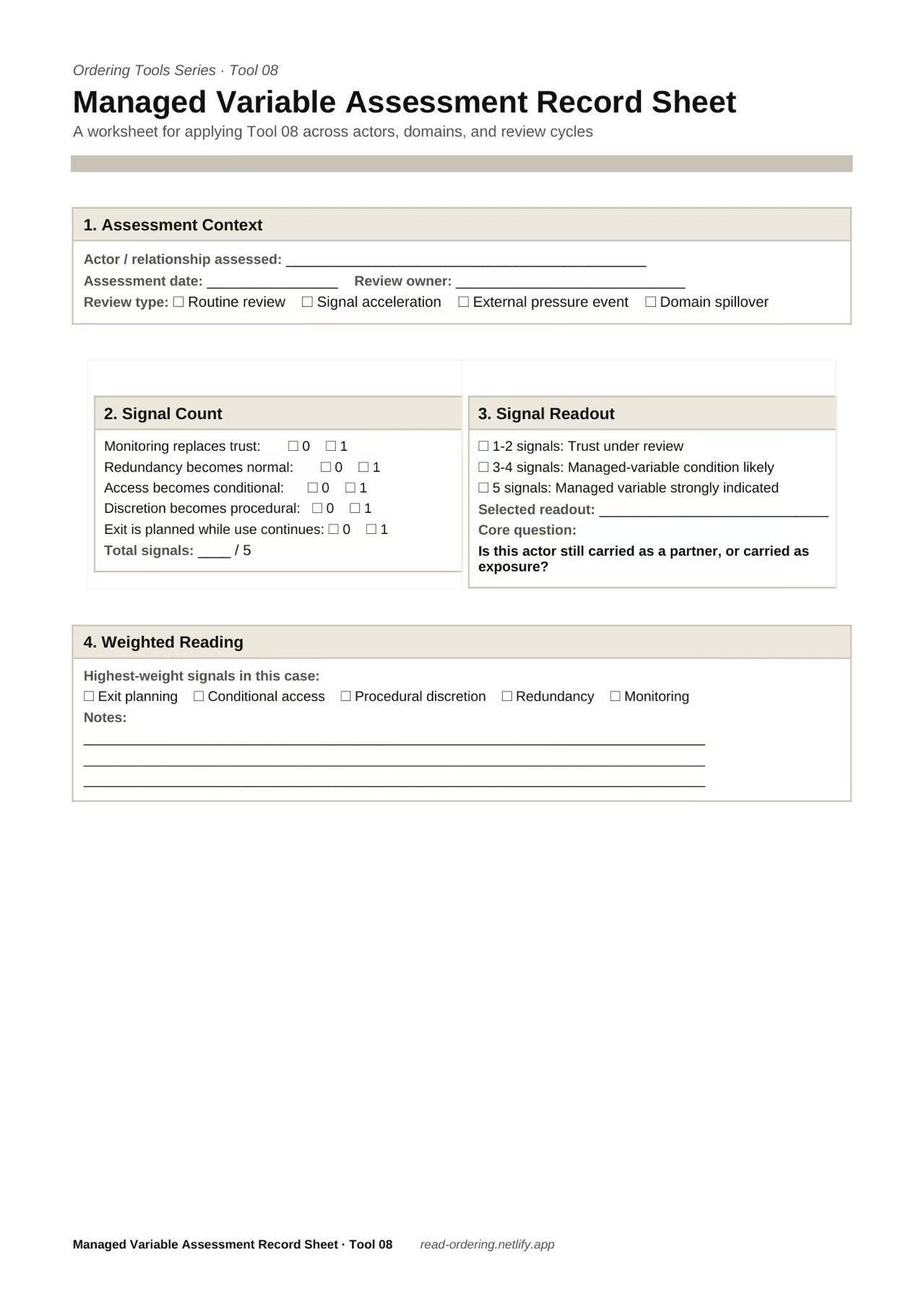
It records:
signal count;
weighted reading;
domain map;
review trigger;
carrying strategy;
next review date.
Use the short Record Sheet when the task is to make a quick assessment of one actor or relationship.
Use the full Managed Variable Assessment Pack when the task requires team review, repeated assessment, sector comparison, or auditability across time.
The Assessment Pack includes the Record Sheet plus appendices for deeper application.
Appendix A — Classification-to-action table
Use this when the result must be translated into standard follow-up actions.
It connects each diagnostic level to practical next steps: trust under review, partial managed-variable condition, managed-variable condition likely, and managed variable strongly indicated.
Appendix B — Indicative sector weighting table
Use this when the relationship belongs to a specific field such as supply chains, cloud infrastructure, AI systems, capital networks, platform governance, or geopolitical relationships.
It helps teams identify which signals should carry greater diagnostic weight in different sectors.
Appendix C — False-signal boundary examples
Use this when the team needs to distinguish routine governance, temporary controls, or trust-deepening oversight from true managed-variable reclassification.
Not every audit is distrust.
Not every backup plan is reclassification.
Not every procedural layer means discretion has been revoked.
The short sheet helps readers apply the test.
The full pack helps teams make the test repeatable, comparable, and auditable.
Example Readout: A Cloud Provider
A firm relies on a cloud provider for critical workloads.
After several continuity concerns and rising data-governance pressure, the firm changes how it carries the relationship.
Monitoring increases.
Service reporting becomes more detailed.
A second provider is qualified for backup workloads.
Sensitive data access is restricted.
Deployment changes now require internal approval.
The firm also begins building export paths so critical workloads can be reduced or moved if necessary.
The cloud provider remains useful.
The relationship continues.
But five signals are now present:
monitoring replaces trust;
redundancy becomes normal;
access becomes conditional;
discretion becomes procedural;
exit is planned while use continues.
The provider remains operationally valuable, but discretionary trust has been withdrawn.
The relationship is best read as managed continuation, not ordinary partnership.
This does not mean immediate exit.
It means the provider should be carried under explicit access boundaries, redundancy, review intervals, and exit capacity.
This example shows a fully reclassified relationship.
Most real-world relationships land at three or four active signals rather than full five-signal classification.
The diagnostic task is the same: count the signals, read what they have replaced, and assess whether the controls are temporary or structural.
The goal is not theatrical rupture.
The goal is correct carrying.
What to Do After Diagnosis
Diagnosis is not a call for automatic removal.
The goal is not always exit.
The goal is correct carrying.
A system that misreads a managed variable as a trusted partner may carry unpriced failure cost into the next crisis.
A system that misreads a still-useful actor as an enemy may destroy capacity it still needs.
The task is to carry the relationship according to its actual trust status.
If the Actor Is Still a Partner
Do not over-manage the relationship.
Excessive controls may create the distrust they claim to prevent.
Keep early signals visible, but do not convert ordinary trust into procedural suspicion without cause.
A partner relationship requires room for judgment.
If every act must be pre-cleared, the relationship is already changing.
If the Actor Is Under Review
Separate temporary controls from structural controls.
Ask whether the new constraints will be removed when pressure falls.
Watch for normalization.
Temporary review may be appropriate.
But if review becomes permanent, if redundancy becomes mandatory, if access remains conditional, and if exit planning continues after the triggering pressure has passed, the relationship may be moving into managed-variable status.
As noted in the result reading, the question is not only what changed.
It is whether the change can still reverse.
If the Actor Is a Managed Variable
Do not pretend the relationship is still ordinary partnership.
A managed variable should not be romanticized as a partner.
It should not be reflexively destroyed as an enemy.
It should be carried according to its actual trust status.
Use a three-layer carrying strategy.
Layer 1 — Containment
Define access boundaries.
Limit sensitive data, decision rights, infrastructure reach, strategic information, or security-sensitive functions.
Move discretionary actions into explicit approvals or prescribed workflows.
Containment does not mean rejection.
It means the actor’s useful function is retained while unbounded discretion is reduced.
Layer 2 — Substitution
Build alternatives deliberately.
Qualify secondary suppliers.
Develop backup platforms.
Prepare alternative capital sources.
Create substitute technical systems.
Do not confuse redundancy with hostility.
Redundancy is carrying discipline.
Layer 3 — Exit Readiness
Test whether the system can reduce, migrate, or bypass the relationship if failure cost rises.
For critical dependencies, run periodic exit drills.
Exit readiness does not require immediate exit.
It prevents usefulness from becoming captivity.
The task is to align carrying rules to actual trust status.
Misuse Boundary
Not every audit or backup plan signals reclassification.
Routine governance and prudent risk management exist independently.
The managed-variable shift occurs only when usefulness remains while trusted discretion is deliberately withdrawn and the new controls become persistent.
The shift requires three conditions:
The actor remains useful.
The actor loses discretionary trust.
The new controls become persistent, normalized, and difficult to reverse.
Temporary controls do not equal reclassification.
Routine governance does not equal distrust.
Scale-related process does not equal managed-variable status.
Some controls increase because trust has deepened, not because trust has collapsed.
A partner that passes a severe audit may receive broader access afterward.
A supplier that performs under disruption may gain discretion rather than lose it.
In those cases, governance has matured, but discretionary trust has not been revoked.
Some relationships deepen under pressure because repeated stress confirms alignment.
The boundary is structural:
Has the system withdrawn trust from the actor’s discretion while continuing to use the actor’s function?
If not, the actor may be monitored, audited, or governed.
But it has not necessarily become a managed variable.
Where This Tool Applies
The Managed Variable Test can be used anywhere a system continues using an actor while reducing trust in that actor’s discretion.
In supply chains, it applies when a critical supplier remains necessary but is surrounded by buffers.
In cloud infrastructure, it applies when a provider remains useful but exit planning becomes mandatory.
In AI systems, it applies when model capability remains valuable but output discretion is constrained.
In capital networks, it applies when funding remains useful but governance rights, access, or influence are limited.
In professional services, it applies when a firm remains embedded but its judgment is no longer trusted unbounded.
In platform governance, it applies when a platform remains central but its discretion is constrained by regulation, interoperability rules, oversight, or structural remedies.
In geopolitical relationships, it applies when a state remains necessary but trust is replaced by hedging, conditionality, and strategic redundancy.
The field changes.
The diagnostic question remains the same.
Is the actor still trusted, or merely managed?
What Ordering Adds
The standard language often speaks of vendor risk, supplier risk, platform dependency, de-risking, decoupling, compliance tightening, or strategic hedging.
Those terms are useful.
But they often describe symptoms.
Ordering adds a relationship-classification test.
The question is not whether the relationship continues.
The question is what kind of relationship is now continuing.
A system may keep using an actor long after it has stopped trusting the actor as a partner.
Tool 08 is designed to detect that interval.
It gives language to a condition many systems experience before they name it:
the actor remains useful;
the actor loses discretion;
the relationship continues;
the carrying logic changes.
That is the managed-variable condition.
Downloads
Managed Variable Assessment Record Sheet
A short worksheet for applying the Managed Variable Test to one actor or relationship.
Managed Variable Assessment Pack
A fuller institutional-use pack including the Record Sheet, classification-to-action guidance, sector weighting references, and false-signal boundary examples.
Direction to Ordering
Use this tool to see relationships as they actually are — not as they appear at the interface.
This tool extends Chapter IV of Ordering and Working Paper No. 03, From Partner to Managed Variable.
It turns the managed-variable mechanism into a practical test.
Ordering Applied Brief No. 01, The Managed Variable World, describes the broader cross-domain pattern this tool is designed to diagnose.
The Applied Brief identifies the pattern.
This tool provides the test.
The papers develop the mechanisms.
The book develops judgment.
Book + Papers + Notes + Archive:
https://read-ordering.netlify.app/
Series guide and framework overview:
https://doi.org/10.5281/zenodo.20485150
Citation:
Reed, C. (2026). Tool 08: The Managed Variable Test. Notes on Ordering. Retrieved from
